
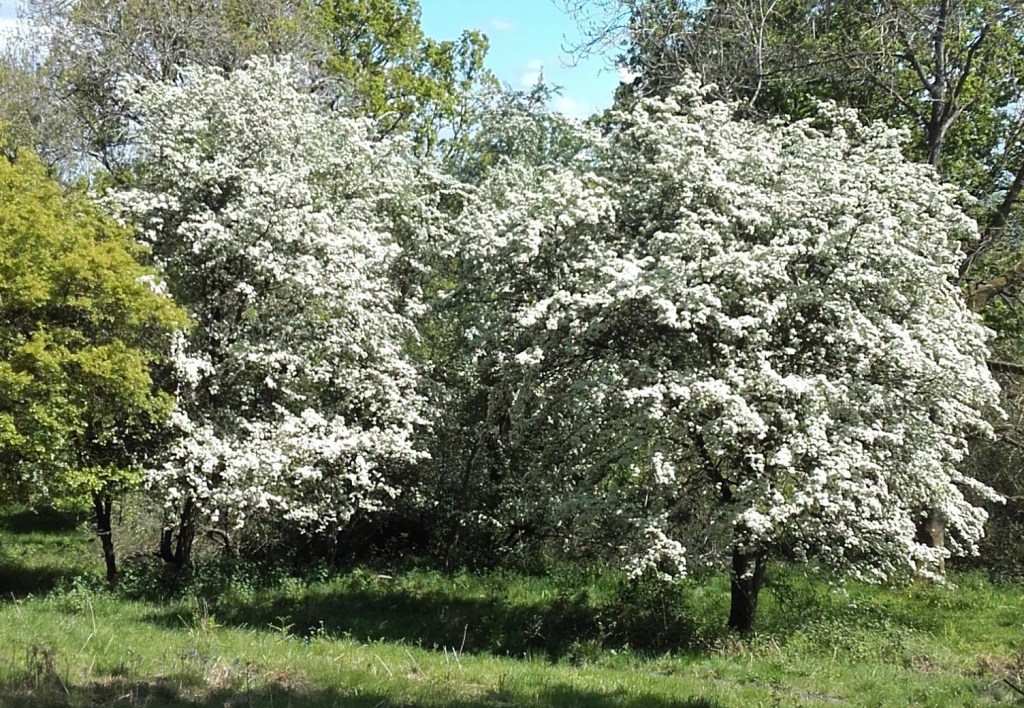
In the spring of 1994, I was a third-year student at a small, Welsh University, living in a hall of residence that looked out over hills and fields. From the kitchen window, I could see a particularly fine hawthorn bush. As spring progressed, I watched it bloom with such a mass of bright white flowers that the whole bush shone with a dazzling whiteness. I’d never noticed hawthorn before then and I thought it was the most beautiful thing I had ever seen. I was amazed that a plain, boring bush could change into a thing of radiance. The whiteness reminded me of a bridal gown, and in my mind, the bush was a plain, ordinary woman, transformed into a beautiful bride on her wedding day. Then, as the days passed, the white flowers gradually started to turn pink and rosy. The bride was now blushing, enjoying her wedding night.
The idea stuck with me. A couple of years later, when I was working in the bookshop, I used my day off to go for a walk in a nearby country park. As was my usual habit, I was carrying a notebook and pen. When I came across a bench in a quiet spot, I sat down and started to write. That story was The Hawthorn Bride. It was set in a small, rural village, in some bygone era when life was simpler; if a man wanted to marry a girl, all he had to do was ask her to dance with him at the May Ball, and the engagement was settled. The main character is a young man called John, who was determined to find himself a wife. Having had his heart broken once, he takes a chance on the plain, unlovable daughter of the blacksmith, and gives her the chance to blossom. And like the hawthorn bush that she is analogous with, she is called May.
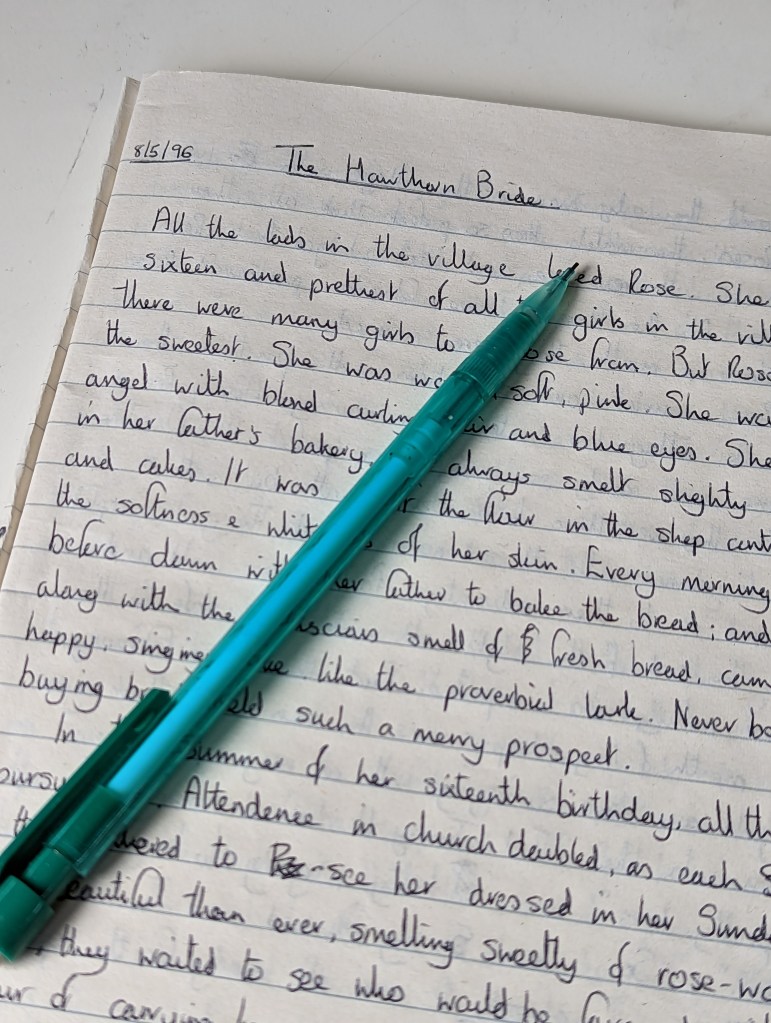
I wrote quite a few pages that day back in 1996. It took me by surprise how the thing just came to life, sitting there on a bench, scribbling away. Maybe I was inspired by my surroundings – a lovely spring day and the gentle rural environment of Warwickshire rolling around me. It was certainly a change from the fantasy novel I was in the middle of writing. I didn’t think it was a complex enough idea to make a complete novel, but I had a plan to link it with two other stories to make it a work of three novellas, loosely linked around the theme of love – past, present and future. I never did finish the fantasy novel, abandoning it in favour of novels with historical, rural settings grounded in every day lives, exploring the characters through the nature of their relationships. Without planning it, I completely changed my writing style to suit my Hawthorn Bride idea. So, when I was looking for a new project after setting up this website and publishing my other novels on Kindle, it made perfect sense that I returned to that story, now as a stand-alone novel.
And yes, I have written about this before, because the futuristic story of the trilogy of novellas featured a killer pandemic, something that seemed eerily prescient when Covid-19 threw us all into lockdown. And while I chose not to write about pandemics, I did finish the first draft of The Hawthorn Bride during the subsequent lock-down. (Self-isolation – a good time to write a novel)
I had been working on The Hawthorn Bride for some time before lockdown. I had been making notes, developing back-story, and doing basic research into Victorian village life for a few years. I started writing out-of-sequence episodes and experimental chapters around 2018/19, but was finding it slow and hard to get into. I knew what I wanted the novel to be. Yes, it’s a love story, but I didn’t want it to be sentimental or romantic. I wanted it to be more about the psychology behind love and relationships. My main character John is a practical man who thinks that finding a wife is merely a practical matter, but he discovers how even that can lead to intimacy and commitment between two people. When we first meet May, we see her how everyone in the village sees her – dull and sour – but obviously, there is much more to her than that, as there is to everyone, and as John is to learn. It is a love story, but it’s not just about them meeting and falling in love, with a wedding for a happy ending. It’s as much about the life that comes after the wedding when relationships change and develop. However, this made it harder to write. I didn’t want anything sensational to happen, but I did worry for a while that this made it a bit boring. But in the end, I had faith in my characters and my ability to tell their story; it’s better to have a simple story written well than a thrilling idea badly executed. The extra time of lockdown was a bonus that helped it to all fall into place and I was really pleased with the result.
And since coming back to it for a final edit, I was pleased to find myself still feeling this way. It’s much shorter and simpler than either of my other adult novels, but that’s what makes it different and – dare I say it – worth reading. Because, obviously, that’s what I want. The years of work aren’t just for my pleasure, but to reach the end point of publication and sharing it with the world. It’s a nerve-wracking moment, deciding when it’s time to stop editing and make it available to read. In reality, the editing could go on forever, and as a writer, I will always see ways that I could keep on improving my work. But I am confident that it is now ready. I’ll even go as far as saying that I think it is good. I am sure of it. I enjoy reading it, and that gives me hope that other people will too. So, from that idea scribbled in a notebook on a lovely May morning in 1996, here is The Hawthorn Bride, available NOW, on Kindle, for the very reasonable price of £1! I would love you all to read it.
PS – Did you know, you don’t need an actual Kindle to read Kindle e-books? The Kindle App is easily available for most smart phones and is free!
PPS – There are bound to be some mistakes. I have read and reread the manuscript multiple times, but it’s just impossible to spot them all. I apologise in advance and just hope there aren’t too many.

 M J Schofield