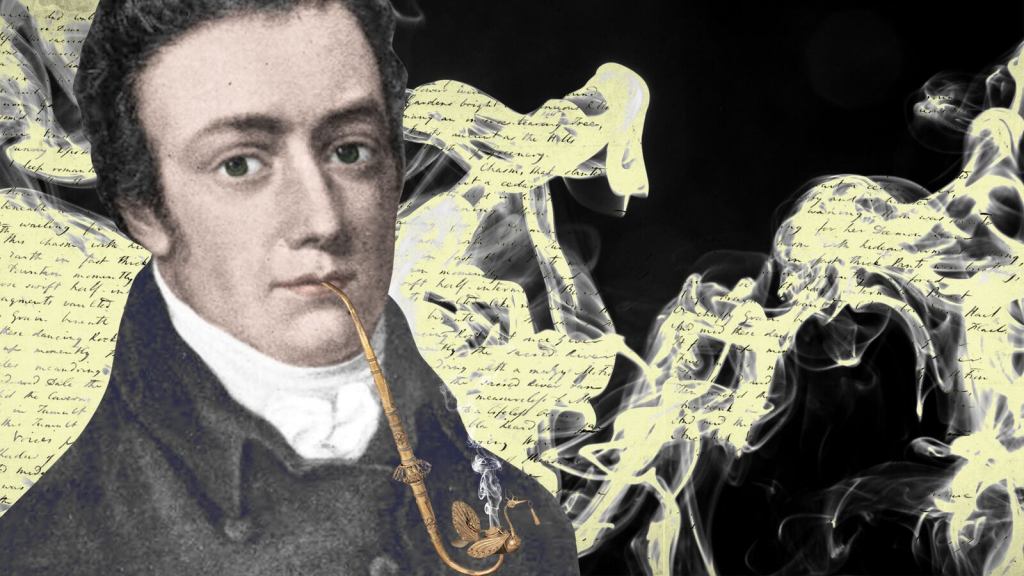
On awakening he appeared to himself to have a distinct recollection of the whole, and taking his pen, ink, and paper, instantly and eagerly wrote down the lines that are here preserved. At this moment he was unfortunately called out by a person on business from Porlock, and detained by him above an hour, and on his return to his room, found, to his no small surprise and mortification, that though he still retained some vague and dim recollection of the general purport of the vision, yet, with the exception of some eight or ten scattered lines and images, all the rest had passed away like the images on the surface of a stream into which a stone has been cast, but, alas! without the after restoration of the latter!
These are lines written by the poet Samuel Taylor Coleridge about his experience of writing his famous poem Kubla Khan. Like many literature students, I studied this poem for essays and exams, and loved the language without ever understanding it. But this story from the preface to the poem fascinated me more. It seemed to be a glimpse into the mind of a writer, a peek through the window at the mysterious process of writing. It is also terrifying – to have ideas, and then lose them, “like the images on the surface of a stream into which a stone has been cast, but, alas! without the after restoration of the latter!” It perfectly describes the frustration of crafting the best words in one’s head and then losing them.
It is no surprise that the phrase “person from Porlock” has become code for the frustrating interruption to the creative process. Pity the poor author, dragged away from the world that only exists in their head to deal with the mundane issues of the real world. But to me, it is worse than that. It is the loss of the words themselves that is truly terrifying. It can be crushing and debilitating, as I found out recently, when I thought I had lost weeks’ worth of work.
My 21st Century version of the person from Porlock came in the form of a computer malfunction. Well, computer user malfunction is probably more accurate. For the past couple of months, I have been working on another edit of my novel. The AI editing tool that I use has new features, which I was using to make improvements, chapter by chapter. I was working on my main manuscript, and being a cautious person, I was using the Tracking Tool so I could review any changes I made before accepting them. I don’t know if this is helpful or not, as I very rarely go back to the original, so it’s probably just sentimental attachment, or superstitious nonsense that makes me nervous of sudden change. However, the work was going well, and I was really pleased with the adjustments. Last Sunday, having reached the final chapter and reviewed everything multiple times, I hit Accept All and sat back to bask in yet another Draft. I’ve lost count of what number it is; maybe the 5th, or 6th.
Anyway, within a couple of days, new ideas were already nudging me – make this change here, add this line there. But when I looked at the document, the changes weren’t there. I scrolled up and down, trying to find the chapters where the biggest changes had taken place, but nothing was different. Being a computer Luddite, I couldn’t understand. I looked in different folders and documents, feeling sure that I was just looking in the wrong place. I knew I had made those changes, so why hadn’t they saved? Had I mistakenly hit Reject All instead of Accept All? But that didn’t make sense either, because there had been some chapters that I had accepted the changes already in order to run a critique report, and of which I had evidence, yet those changes had disappeared too. It really did seem as if my laptop had decided for me that the new version was no good and had reverted to a much earlier version.
For a grim twenty-four hours, I was faced with the prospect of starting the work all over again. Work that took me three months to do. This was frustrating, but not so terrible – the loss of time was inconvenient, but there’s no time pressure on this work, so another three months wouldn’t be a problem. But what really frightened me was knowing that while some of the changes were still in my head and could probably be rewritten word for word, not all of them were. Some would elude me, like Coleridge’s broken images on the surface of a stream; they would never come back as they had been. Of course, if all the changes came from my head the first time, they could happen again. But knowing that words had previously pleased me were now lost was not just frustrating, but crippling. I could stare at the page, remembering when I had spent a whole day perfecting a single paragraph, and feel nothing but resentment and fury that I couldn’t get those words back. That’s not conducive to the creative process.
Thankfully, I did find the altered document. I’m too much of a Luddite to even explain where or what caused it to happen, and I don’t care now that I have it back. Needless to say, I now have multiple back-up copies of every document, and I never close anything down without double-checking everything is synced and connected. But this blog isn’t meant to be a cautionary warning about saving work and adequate back-up measures – it’s about the feeling of loss and dread when words won’t come back; the ‘mortification’ as Coleridge puts it. Not everybody believes Coleridge’s story about the person from Porlock. It has been suggested that he wrote the preface to hide the fact that he was finding this poem difficult to write, and he needed a cover-up for its fragmentary nature. But those words, “passed away like the images on the surface of a stream… alas! without the after restoration of the latter!” resonate with me so much. I can feel the truth in them, whatever the reality behind the story. For a writer, it is the worst nightmare.
Always back up your work, folks!

 M J Schofield